
A Guide to CLP Labelling for Candles and Wax Melts
Why do I need to do it?
Labelling your candles is very important and you could very well be breaking the law if not done correctly. You may well have heard about CLP and you will know that it’s a piece of legislation that candle makers must comply with and here is why.
The regulation in practice here is the EU’s Classification, Labelling & Packaging Regulation (CLP) specifically (EC) No 1272/2008 which after 1st June 2015, stipulated that all new products with hazardous substances must be labelled accordingly.
CLP applies to a non-cosmetic product of any size containing a hazardous substance such as fragrance or essential oils (e.g. candles, wax melts, room mists, reed diffusers etc).
Candles & melts come under CLP simply because most fragrance oils and essential oils are deemed in their neat state (i.e. 100% oil) to be harmful in one way or another. This could be because they are flammable, pose a risk to health (e.g. a skin irritant, an eye irritant, a carcinogenic) or it can pose a serious hazard to the aquatic environment.
If hazardous components are present at certain concentrations, they trigger various health or environmental warning statements and safety pictograms. It’s your job to make sure your candle labels are showing the right thing.
What do I need to do?
If you are making and selling candles you are responsible for having a relevant CLP label for each and every one of your products.
Under the CLP regulations, you must assess what hazards are present in your products and label your candles/wax melts accordingly. This means taking the SDS for the neat oil and working out which, if any, hazards are triggered at the level used in your final product.
Most suppliers will give you the SDS for the neat product at 100% and one for 10%. If you use more than 10% oil in your final product, if you are creating your own custom blend by mixing fragrances, or use the oils with a hazardous base, you will need to work out how these hazardous bases affect the CLP label and amend it accordingly.
For example, if you are creating your own custom blend by mixing fragrances, according to the regulations, it MUST have its own specific SDS as mixing two chemicals together will in turn create a new chemical with potentially different properties and hazards.
If the candle is not classified (i.e. it DOESN’T contain any ingredients that are classified as hazardous) then there is no requirement for it to be labelled in accordance with CLP. The wax used in candles is very unlikely to be classified as hazardous, however it is the fragrance oils that will be the main concern.
Safety Data Sheets (SDS) & CLP Compliant Labelling
A Safety Data Sheet (SDS for short) is essentially a safety document that determines ingredients in a particular mixture. It contains contact details of your supplier and other important safety information including potential hazards, information on handling and storage as well as emergency measures in the case of an accident.
In most cases an SDS will be provided by your supplier for 10% fragrance, as this is generally the maximum concentration that a candle can hold. It will also be provided for 100% concentration, as this is the concentration that you will be handling the fragrance oils in.
With the SDS, you can technically create CLP compliant labels for your candles which will have the following information:
- Product identifiers
- Hazard pictograms
- Hazard statements
- Allergen information
- Signal words
- Precautionary statements
- Supplier information (your business address and contact number)
An Example of a CLP Label
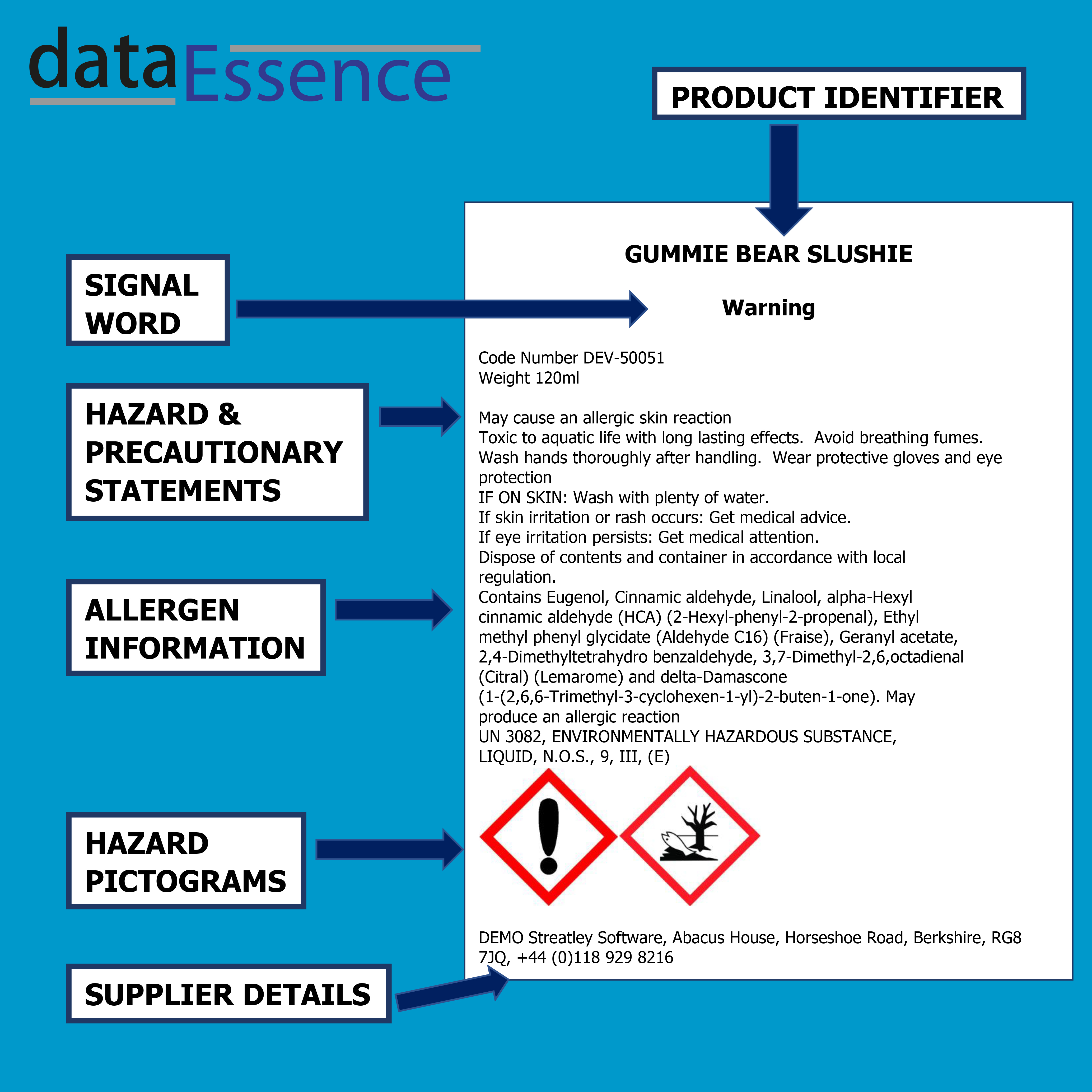
Here’s an example of a label just to make things a bit clearer (all the different components have been labelled):
Label Elements
- Supplier Address and No. The name, address, and telephone number of the supplier.
- The nominal quantity (unless this quantity is specified elsewhere on the package) (i.e. the weight)
- Product Identifiers. As a general rule, the term used for identification of the substance or mixture should be the same as that used in the safety data sheet
- Hazard pictograms. A hazard pictogram is a pictorial presentation to communicate information on the hazard concerned.
- Signal words. A signal word indicates the relative level of severity of a particular hazard. The label must include the relevant signal word in accordance with the classification of the hazardous substance or mixture: more severe hazards require the signal word ‘Danger’ while less severe hazards require the signal word ‘Warning’.
- Hazard Statements. The Hazard Statements are those that provide the consumer with a direct warning as to what the mixture may do – the nature of the hazard. If a Hazard Statement is triggered by a particular ingredient at a specific concentration, it MUST be included on the label, along with its relevant pictogram.
- Precautionary Statements. The Precautionary Statements are a set of instructions that advise the customer how to avoid or minimise the hazards that may be caused by the hazardous mixture.
- Statements. The regulations state that ‘relevant’ precautionary statements should be included, with some being mandatory, others recommended, and others advised.
Understanding what is required of you
As a candle maker, you are entitled to an SDS from your supplier for any fragrance oil which has been identified as being potentially hazardous.
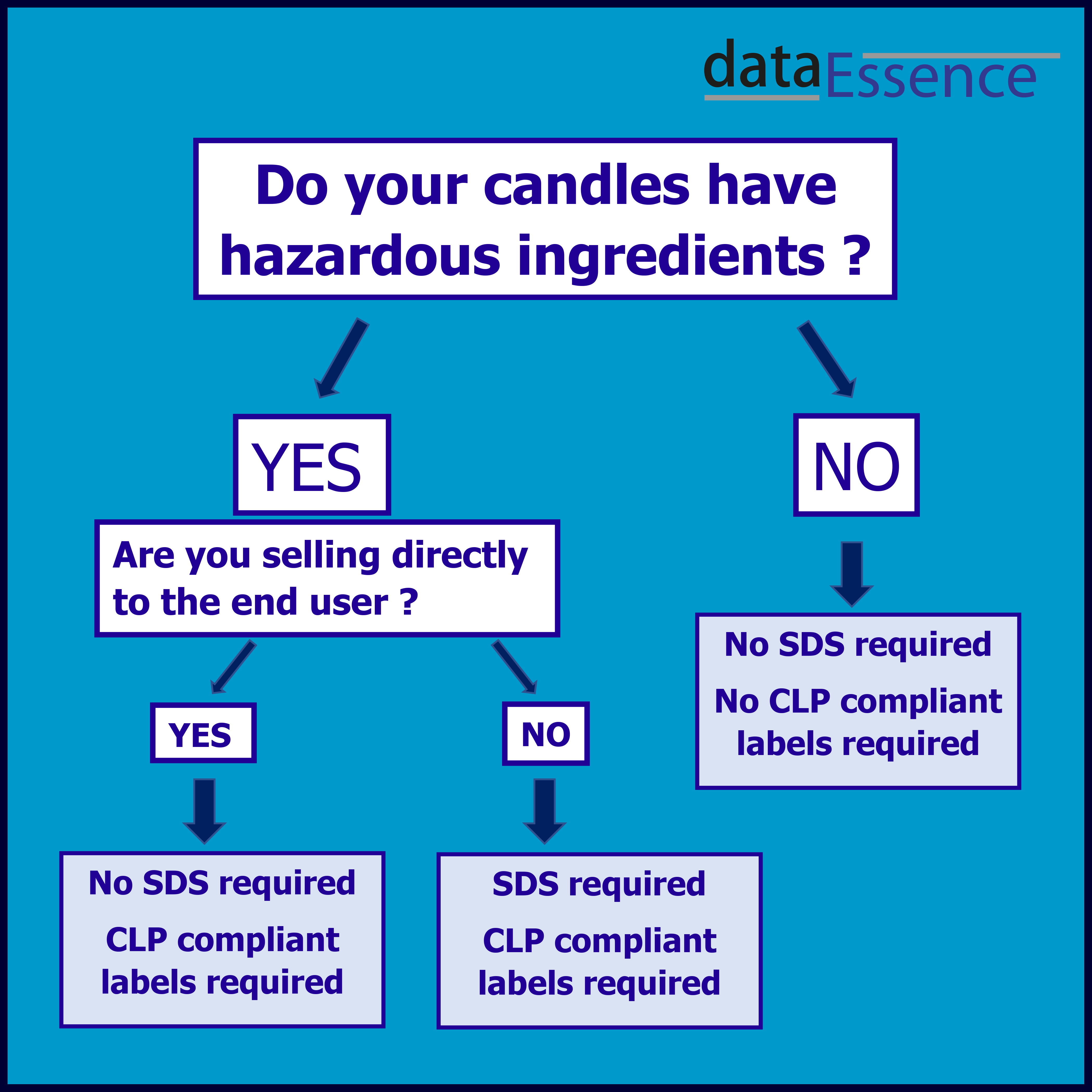
If you are selling your candles directly to your customers who will be the end users, you won’t need to supply a SDS but you will need to ensure your candles are labelled correctly, according to CLP regulations - this label will give all the consumer information required.
If you are not supplying directly to the end user (e.g. you may be selling to a hotel or a lifestyle shop) then an SDS will have to be given by you to the retailer for each fragrance oil used in the candles you supply them.
Remember if your candle isn’t classified as hazardous/doesn’t have any hazardous ingredients, you won’t need to even label them under CLP law.
All the above information has been nicely summarised in the flow chart below:
Further Reading and Support
We strongly recommend that you read some of these articles and documents, as well as doing your own research.
- European Chemicals Agency (ECHA) - https://echa.europa.eu/regulations/clp/legislation
- Health and Safety Executive (HSE) - http://www.hse.gov.uk/chemical-classification/legal/clp-regulation.htm
- If you would like make sure that you are compliant you can contact your local Trading Standards and seek their advice on these regulations https://www.gov.uk/find-local-trading-standards-office
- The British Candle Makers Federation http://www.britishcandles.org/
You can certainly learn how to calculate the CLP labels yourself using the information (Safety Data Sheet) for the fragrance provided by your supplier; it does take some time and effort to become confident in this but with thorough reading of the regulations and lots of research it can be done.
However, if you would like to find out more about how we can provide you with training and software for calculating your own CLP and SDS labels for your own product range please do get in touch for a demonstration.... we’ll be more than happy to help!
Contact Us

Briefs & Submissions
Formulation Design
GHS/CLP, IFRA, FEMA
Works Orders
Batch Tracking
...and much more


